Marketing is not ineffective simply because businesses lack budget. The issue often lies in the fact that strategy, people, data, and execution have not been connected within a unified system where every Marketing activity plays a clear role in achieving business objectives.
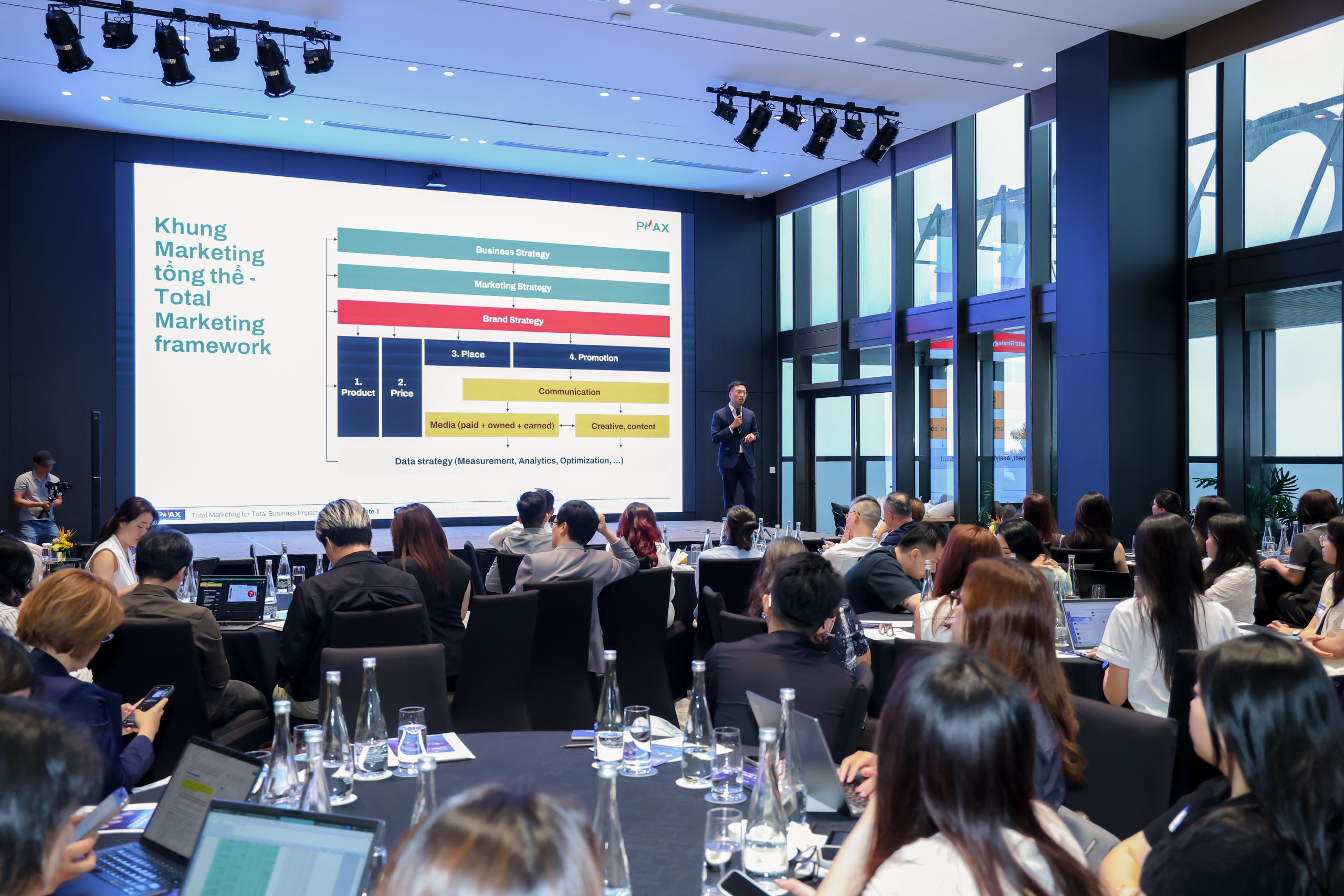
This is the foundational perspective of the Total Marketing Framework, a marketing system design framework developed by PMAX, as presented by Mr. Lê Xuân Long, CEO of PMAX.
Instead of approaching Marketing as an independent communications function, the Total Marketing Framework places Marketing in close connection with the company’s business strategy, value chain, and data system. The ultimate goal is not simply to create more activities, but to enable all Marketing resources to contribute collectively to growth.

Departments achieve their targets, but the business does not necessarily grow
A common paradox in businesses is that every department meets its targets, yet overall business results still fall short of expectations.
The Sales team may push a lead product to achieve its order KPI. However, if this product does not create a conversion journey toward the core product portfolio, the business may increase its number of orders without achieving a corresponding improvement in profit.
Similarly, a Marketing campaign may achieve its reach, engagement, or lead generation targets but still fail to create a tangible business impact. This occurs when communications results are not connected with sales data, customer quality, lifetime value, or the insights required for the next cycle.
Therefore, the problem does not necessarily lie in the capabilities of individual departments. The disconnect lies in the system design: each unit optimizes for its own targets but does not share responsibility for a common business outcome.
The common language of CEOs, CFOs, and Marketing is investment efficiency
The advertising industry’s classic paradox that businesses know part of their budget is being wasted but cannot identify exactly which part reflects a broader challenge: Marketing often struggles to demonstrate its role using the language of business management.
At the event, Mr. Lê Xuân Long stated: “If Marketing cannot answer questions about performance, it will be very difficult to engage with CFOs and CEOs at the business level, while also making it difficult for Marketing to secure an appropriate position in the company’s strategic decisions.”
Reach, engagement, and the number of leads remain necessary signals for evaluating performance at each stage. However, from the leadership team’s perspective, these metrics only become truly meaningful when they are connected with ultimate impacts: revenue growth, profit, market share, customer value, or long-term brand strength. In other words, Marketing needs to move beyond the question of “how many communications results did the activity generate?” to answer a larger question: how did this investment contribute to the business objectives?
When Marketing can establish a clear connection between investment, activities, and results, discussions with CEOs and CFOs no longer revolve solely around defending the budget. Marketing can participate more deeply in defining the company’s growth priorities and resource allocation.
Total Marketing Framework: Connecting business strategy with data
The Total Marketing Framework was developed by PMAX to position Marketing appropriately within the company’s strategic system, rather than narrowing its role to a communications function.
According to the framework, every Marketing decision needs to begin with the Business Strategy. From the business direction, the company translates it into a Marketing Strategy and Brand Strategy before implementing the four components of Product, Price, Place, and Promotion.
Within this structure, Promotion is only one branch of the system, encompassing Communication, Creative, and Media. These components need to be connected with a shared data layer so that the business can:
- Measure performance across the entire system instead of monitoring individual channels separately.
- Identify disconnects between Marketing and Sales.
- Transform execution results into lessons for the next cycle.
- Feed actual data back into the strategic planning process.
PMAX also uses the term Total Growth Framework in certain contexts to emphasize that this is not merely a framework for managing Marketing activities, but an approach to connecting Marketing with the company’s entire growth-generating system.
The framework’s most important value does not lie in the number of components. Its value lies in the connections between those components: from business objectives to market decisions, from execution activities to data, and from data back to strategy.

Value Chain: The foundation of an uninterrupted system
To address fragmentation between departments, PMAX applies Michael Porter’s Value Chain thinking to the Marketing system design process. Under this approach, all value-creating activities from: research and development, production, operations, and distribution to Marketing, Sales, and after-sales services are viewed as a connected chain rather than as independently operating departments.
The four components of the Marketing Mix are present throughout the value chain:
- Research and development activities are directly related to product strategy.
- Production capabilities and the supply chain affect costs and pricing policies.
- Operating and distribution models determine market accessibility.
- Marketing and Sales connect the brand with demand, conversion, and customer relationships.
At the seminar, PMAX shared the case of a protective equipment distributor that had developed three layers of competitive advantage: a strong position in product safety, a cost advantage through supply chain optimization, and brand strength built through an engaged customer community.
These three advantages did not come from an individual communications campaign. They were created when decisions concerning products, operations, distribution, branding, and customer relationships collectively served a unified business direction.
This is the difference between executing Marketing and designing a growth system in which Marketing serves as a connecting capability.
From a strategic framework to execution capabilities
The Total Marketing Framework provides businesses with a roadmap for evaluating and redesigning their Marketing systems from the ground up. However, a roadmap only creates value when it is transformed into an operating model suited to the reality of each organization.
This process requires businesses to clarify several issues:
- What role should Marketing play in the growth strategy?
- Which metrics should departments collaborate on and share responsibility for?
- Which data must be connected to create a unified view?
- How should the budget be allocated according to objectives and performance?
- What mechanisms can help the organization continuously measure, learn, and adjust?
Through its Total Marketing Consulting solution, PMAX works alongside businesses to transform the strategic framework into specific organizational models, operating processes, measurement systems, and implementation roadmaps.
The goal is not to apply the same model to every business. The goal is to build a system suited to the strategy, scale, internal capabilities, and development stage of each organization.
Marketing creates growth when the entire system operates together
Marketing cannot create a comprehensive impact if it is only responsible for communications. Similarly, businesses will struggle to achieve sustainable growth if departments continue optimizing separately without a shared mechanism for connection and learning.
When Marketing is designed as a system, strategy guides execution; data helps validate decisions; and market results feed back into improving the strategy. This is how businesses move from executing numerous Marketing activities to building a growth capability that can be measured, accumulated, and continuously improved.
PMAX has compiled all content related to the Total Marketing Framework and Marketing Operating System in the Total Marketing for Total Business Impact ebook.
Register to receive the Total Marketing for Total Business Impact ebook here
About PMAX
Founded in 2016, PMAX is a Total Marketing Partner that works alongside businesses to build comprehensive Marketing ecosystems, connecting internal resources with a network of strategic partners to improve Marketing investment efficiency and create a tangible impact on business results.
PMAX provides six solution groups:
- Total Marketing Consulting
- Total Brand Communications
- Total Media
- Total Lead Generation
- Total MCNs Powerhouse
- Data & Tech
After 10 years of operation, PMAX has worked with more than 700 brands, built a team of more than 250 professionals and a network of more than 50 leading industry experts, while also receiving more than 40 domestic and international awards.
Contact us now for a detailed consultation:
- Website: pmax.com.vn/contact-us
- Email: [email protected]
- Hotline: (+84) 28 7300 1778