An effective Marketing Operating System does more than help businesses plan better. More importantly, that system must connect business strategy with budgets, accountability, data, and day-to-day execution, so that the entire organization works toward a shared outcome.
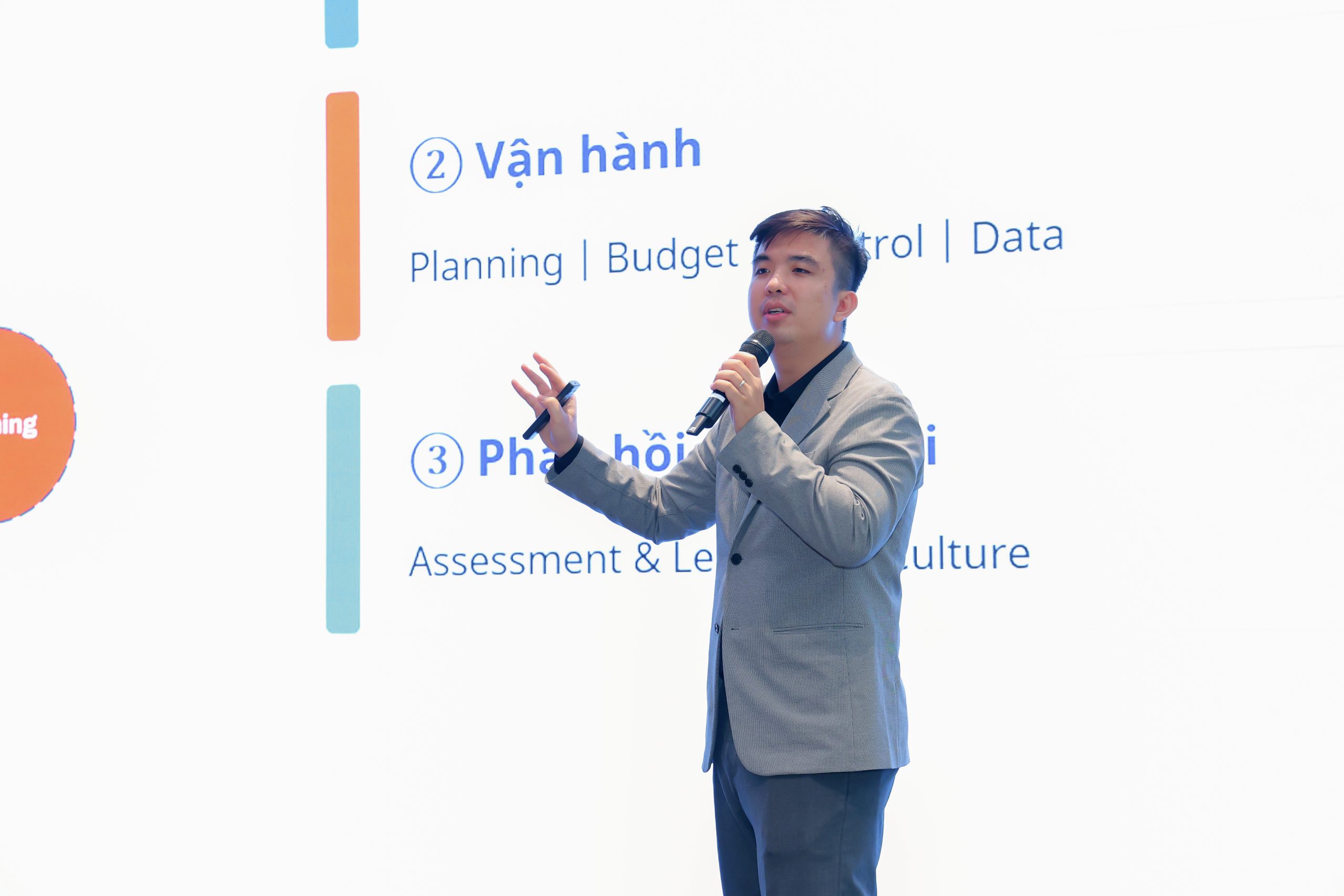
At the Total Marketing for Total Business Impact event, Mr. Nguyễn Mạnh Cường, Consulting Director at PMAX, addressed this challenge through a Marketing Operating System architecture comprising eight component systems, organized into three capability groups: Direction, Operations, and Feedback and Learning.
When businesses cannot track the rate of budget utilization
At the beginning of his presentation, Mr. Nguyễn Mạnh Cường raised a practical question: “How many businesses can confidently say that they know what percentage of this month’s budget run rate has been used compared with the plan established at the beginning of the month?”
The question highlights a common gap in Marketing management. Many businesses still create plans in PowerPoint, track budgets in Excel, and communicate progress via email. Each tool may support part of the work, but when data is scattered across multiple locations, the organization struggles to obtain a unified view of its operations.
The consequence is not merely a lack of budget transparency. Businesses also find it difficult to identify the exact causes when results fall short of the plan.
For example, the Digital team may be assessed as having failed to meet its delivery targets, while the actual cause is the Brand team or agency delivering content late. If plans, tasks, budgets, and responsibilities are not tracked within the same system, departments can easily focus on assigning blame instead of working together to resolve bottlenecks.
This is not simply a tool-related issue. It is an operating design issue: the organization lacks a sufficiently clear mechanism to reveal the relationships among progress, resources, responsibilities, and results.
Marketing Operating System: Three capability groups, eight component systems
A Marketing Operating System can be understood as the operating system of a device: multiple component systems operate together, exchange data, and support one another. Its value does not lie in each individual component, but in the ability to connect them into a unified management mechanism.

1. Direction Group
This group includes the Goal System and Accountability System, helping businesses answer two fundamental questions: where does the organization want to go, and who is responsible for getting it there?
- The Goal System translates business strategy into specific Marketing priorities, from markets and customer segments to growth objectives for each stage.
- The Accountability System defines the role of each department across the value chain while establishing coordination mechanisms and shared accountability for final outcomes.
Without the Direction Group, each team may still perform its own responsibilities well but may not necessarily be working toward the same business priority. Therefore, goals must not only be allocated to individual departments but also be connected both vertically and horizontally across the organization.
2. Operations Group
The Operations Group comprises four systems: Planning, Budgeting, Control, and Data. This is also where many businesses face the greatest challenges when moving from strategy to execution.
- The Planning System helps translate goals into action programs, defining priorities, resources, timelines, and dependencies among departments.
- The Budgeting System connects each investment with specific goals and activities, helping businesses track not only how much has been spent, but also what the budget is being used for and what results it is expected to generate.
- The Control System enables businesses to compare plans with actual progress, identify bottlenecks early, and make adjustments before issues affect the entire campaign.
- The Data System provides a foundation for businesses to measure performance using a shared frame of reference, rather than having each department use a different data source or definition of metrics.
When these four systems are connected, businesses can move from management based on end-of-period reports to proactive management that identifies deviations during operations and intervenes at the right time.
3. Feedback and Learning Group
The final group comprises the Evaluation System and the Organizational Culture System.
- The Evaluation System does not merely determine whether a campaign has achieved its objectives. It also clarifies the causes, the contribution of each activity, and what needs to change in the next cycle.
- The Organizational Culture System ensures that feedback, data sharing, and learning become part of how the business operates, rather than depending on the efforts of a few individuals.
A common situation is that post-campaign reports are presented and then quickly archived. When the next campaign begins, the organization continues to repeat the same approaches because the lessons learned have not been translated into new principles, processes, or decisions.
Therefore, a campaign is only truly complete when the lessons from its results have been fed back into the system and used to improve the next cycle.
The destination is a single source of truth
Businesses may choose different Marketing organizational models depending on their size, industry, and growth strategy. However, a Marketing Operating System must follow one fundamental principle: data must be consolidated into a single source of truth.
This does not mean that all data must be generated by a single tool. Departments may continue using different specialized platforms, but important information concerning goals, plans, budgets, progress, and results must be standardized and connected within the same frame of reference.
When this happens:
- The CEO can see how Marketing is contributing to the business case.
- The CMO can track resources and performance across the entire portfolio of activities.
- Project teams can identify bottlenecks and coordination responsibilities.
- Regions, branches, or points of sale can operate according to the same standards.
- Decisions can be made based on shared data rather than multiple versions of the truth.
A single source of truth does more than improve reporting capabilities. It is a prerequisite for businesses to accelerate decision-making and strengthen accountability across the entire system.
From management architecture to operating tools
Designing the eight systems on paper is only the first step. For this architecture to operate in practice, businesses need a platform capable of connecting plans, budgets, progress, and results within the same monitoring environment.
This is the role of the Marketing Control Tower and the PAXY data platform within PMAX’s solution ecosystem.
The Marketing Control Tower is positioned as an operations center that helps businesses monitor Marketing activities through a unified overview. PAXY plays the role of connecting and standardizing data, supporting the creation of a shared source of information for reporting, analysis, and decision-making.
However, technology cannot replace a management model that has not been clearly designed. For the platform to deliver value, businesses must first establish goals, responsibilities, coordination processes, data standards, and evaluation mechanisms. Technology is the supporting layer that enables the system to operate consistently and at a larger scale.
A strong operating system helps Marketing move from reactive to proactive
An effective Marketing Operating System is not evaluated by the number of reports it produces or the complexity of its tools. The system’s value lies in its ability to help businesses answer important questions quickly and consistently:
- What are we prioritizing?
- Who is responsible for each outcome?
- How is the budget being used?
- Where are the bottlenecks?
- What does the data indicate needs to be adjusted?
- Which lessons must be incorporated into the next cycle?
When all eight component systems operate together, Marketing can move from reacting after problems occur to proactively controlling, learning, and improving. This also provides the foundation for connecting day-to-day Marketing activities with the business’s long-term growth objectives.
PMAX has compiled the complete content on the Total Marketing Framework and Marketing Operating System in the Total Marketing for Total Business Impact ebook.
Register to receive the Total Marketing for Total Business Impact ebook here.
About PMAX
Established in 2016, PMAX is a Total Marketing Partner that works alongside businesses to build comprehensive Marketing ecosystems, connecting internal resources with a network of strategic partners to improve Marketing investment efficiency and create tangible impact on business results.
PMAX provides six solution groups:
- Total Marketing Consulting
- Total Brand Communications
- Total Media
- Total Lead Generation
- Total MCNs Powerhouse
- Data & Tech
After 10 years of operation, PMAX has partnered with more than 700 brands, built a team of over 250 professionals and a network of more than 50 leading industry experts, while earning recognition through more than 40 domestic and international awards.
Contact us now for detailed consultation:
- Website: pmax.com.vn/contact-us
- Email: [email protected]
- Hotline: (+84) 28 7300 1778